Underweight UNDER
- Trigger condition
- Measured value below target − lower tolerance
- Typical causes
- Missing or short contents, underfill, missing leaflet or accessory
Reject to NG bin + count
Each item 5 g – 3 kg weighed in motion at up to 180 pcs/min. Underweight, overweight, barcode mismatch and no-read are judged in one pass and rejected automatically — turning manual spot checks into 100% inline inspection.
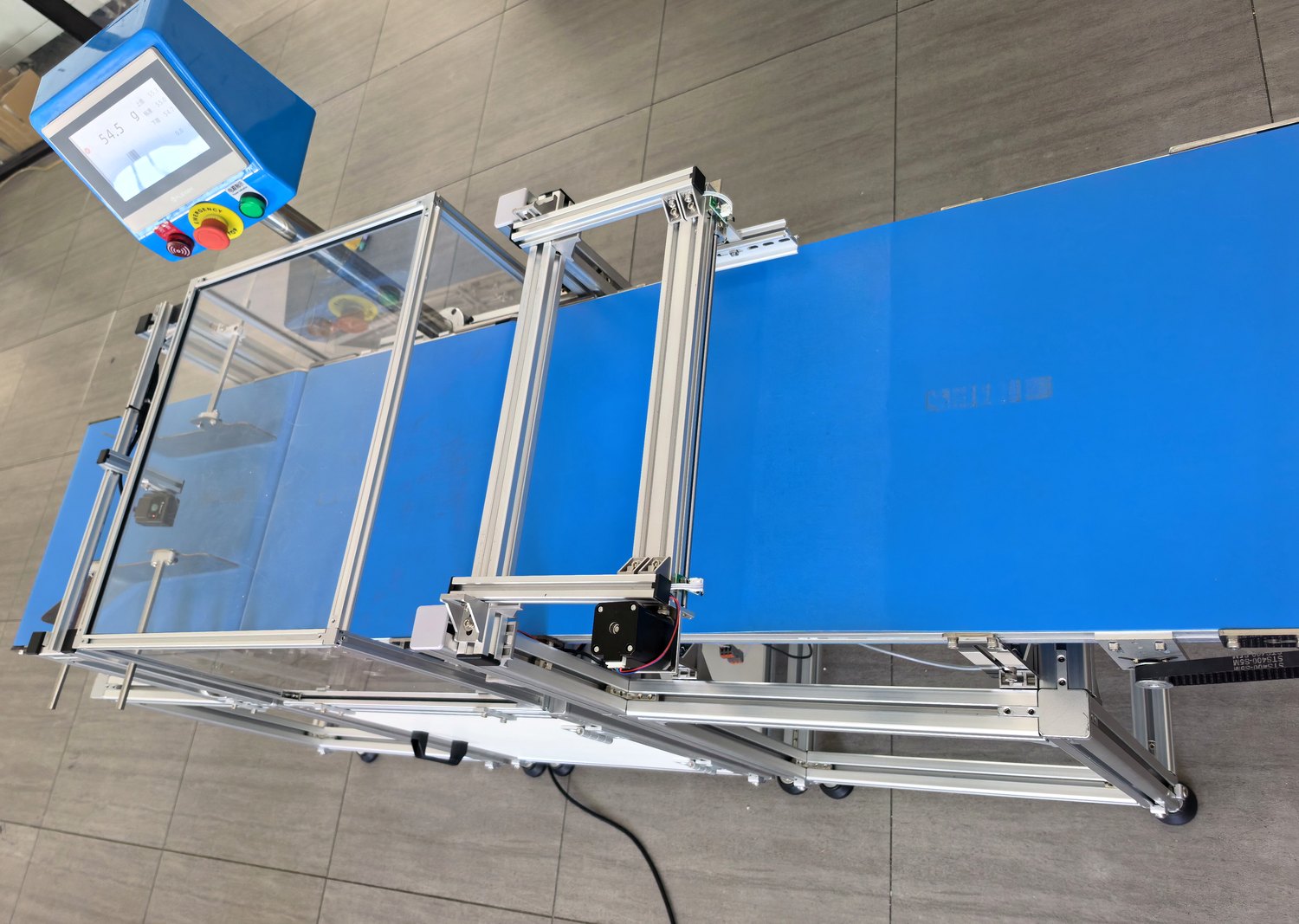 Actual unit · factory setup
A checkweigher is not "put the product on and weigh it". It has to, item after item, while the product is still moving, decide whether this one item should stay, and route it off the line within one cycle.
The Sinocon SK-CW series integrates infeed guiding, dynamic weighing, barcode verification, rejection and data logging in one machine: once a product reaches the weigh section a photoelectric sensor triggers sampling, the controller compares weight window and barcode within milliseconds, rejects are pushed out before leaving the machine and good products continue to packing or case packing.
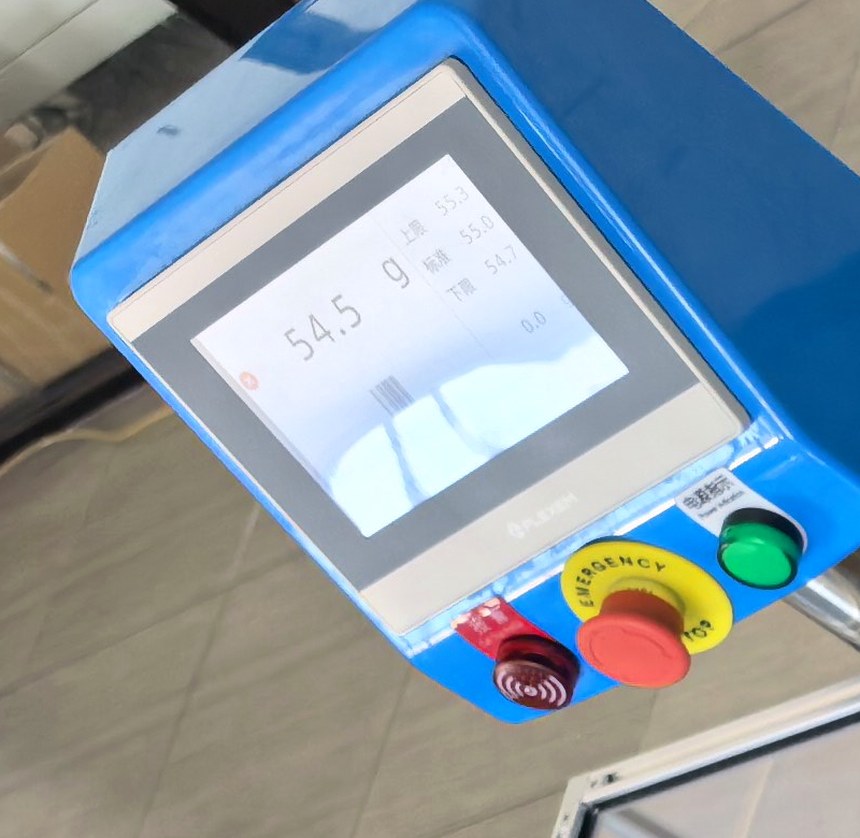 Live: current · upper · target · lower
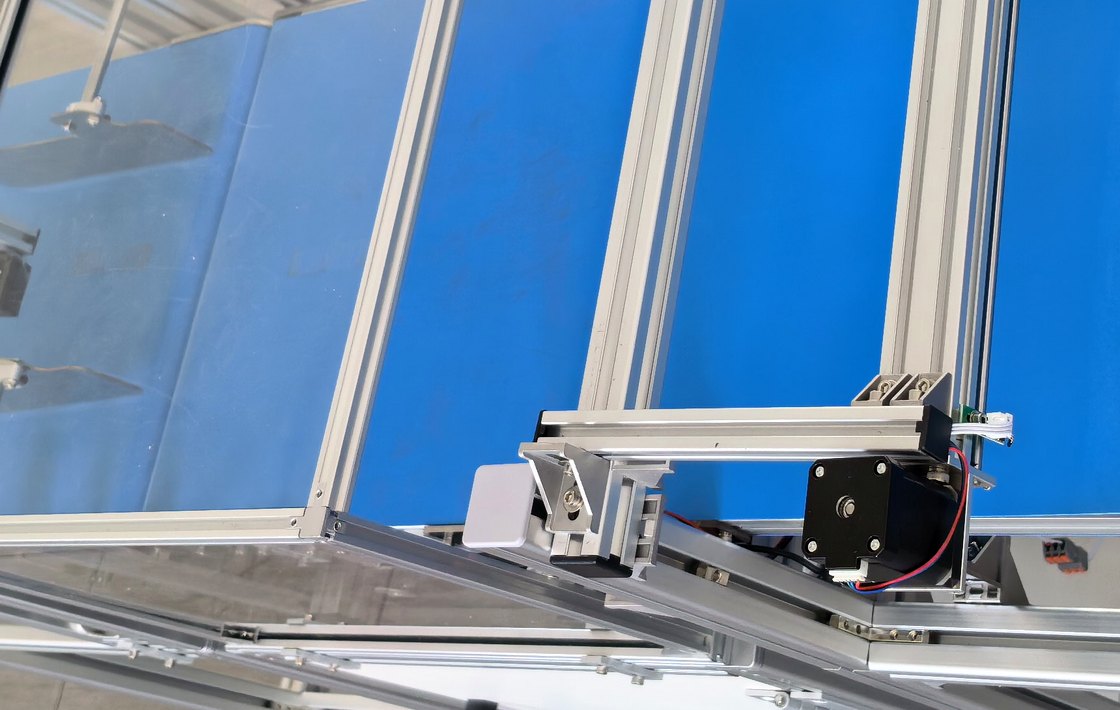
Judgement is not done after weighing: the weight window and the barcode are compared the instant an item passes, and any mismatch outputs a reject signal immediately.
The whole decision chain closes inside the machine — no operator involvement, and no reliance on downstream rework to find defects.
Adjustable guides align and space the products so two items never sit on the weigh section at once.
A photoelectric sensor triggers sampling at the leading edge; only the window where the product is fully on the weigh section is used.
The weigh section is mechanically decoupled from the conveyors and combined with digital filtering to obtain a stable value in motion.
An item passes only if the weight is inside the tolerance band and the barcode matches the recipe; otherwise it is NG.
Rejects are pushed out before leaving the machine, while counters and the shift record are updated.
The honest truth about accuracy: Repeatability depends on the product itself — the lighter, softer or less stable it is, the harder accuracy becomes. That is why a figure of ±0.3 g always carries conditions (reference weight, fixed speed, no air disturbance). The only real way to select is to run your actual product on the machine — sample machine testing is available.
Specifications decide whether it can inspect; the details decide whether the line wants it running every day.
Transition data at the leading and trailing edges is discarded; only the window where the product is fully on the weigh section is used — suppressing belt flutter, frame vibration and interference from neighbouring items.
The screen shows current / upper / target / lower on four lines; out-of-tolerance values change colour and count as NG — operators need to understand no parameters at all.
Target weight and limits are stored per product as a recipe, no recalibration when changing products, so recalling a recipe completes the changeover and cuts downtime.
A correct weight with the wrong label is still scrap. Both conditions must pass, so mixed-label products cannot slip through a weight-only check.
Totals, OK, NG and per-defect counts are recorded by shift, CSV export and Modbus-TCP upload supported — quality reports no longer copied by hand.
Quick-release belts, openable guards, braked castors on the frame. Cleaning and belt changes without stripping the machine and without waiting for a service visit.
Values below are for the standard configuration. The agreed technical protocol and the factory test report prevail.
| Item | Value | ||
|---|---|---|---|
| Machine structure | |||
| Model | SK-CW200 / 300 / 400 | Frame | Industrial aluminium profile + stainless guard |
| Dimensions | Approx. 1200 × 700 × 1350 mm | Table height | 750 ± 30 mm, adjustable |
| Mobility and levelling | 4-inch castors with brakes + adjustable feet | Machine weight | Approx. 180 kg (configuration dependent) |
| Weighing performance | |||
| Weighing range | 5 g – 3000 g (customisable to 6 kg) | Resolution | 0.1 g |
| Repeatability | ±0.3 g (reference weight / fixed speed) | Load cell | Strain-gauge (EMFR optional) |
| Sampling rate | Up to 1,600 Hz | Zero tracking | Automatic (can be disabled) |
| Conveying system | |||
| Belt width | 200 / 300 / 400 mm | Belt material | Food-grade PVC (PU / anti-static optional) |
| Belt speed | 10 – 60 m/min, VFD adjustable | Transfer direction | Left to right (reverse on request) |
| Guiding | Adjustable guides + infeed separation | Max. throughput | 180 pcs/min (depending on product size) |
| Judging and rejection | |||
| Decision method | Upper / target / lower, three-zone tolerance | Rejection method | Push plate · swing arm · air blast · flap (per model) |
| Reject confirmation | Photoelectric read-back + count comparison (optional) | Air supply | 0.5 – 0.7 MPa (air-blast type only) |
| HMI and data | |||
| Display | 7-inch colour touch screen (10.1-inch optional) | Recipe memory | 100 recipes |
| Statistics | Total / OK / NG / by defect type | Export | USB · CSV |
| Comms | RS485 Modbus-RTU (standard) Ethernet Modbus-TCP (optional) | Barcode | 1D / 2D code reading (optional) |
| Electrical and environment | |||
| Power supply | AC 220 V 50/60 Hz | Power | 0.75 kW |
| Protection class | IP54 (IP65 optional) | Environment | 0 – 40 °C, ≤90% RH non-condensing |
| Noise | ≤ 70 dB(A) | Warranty | 12 months on the machine |
← Swipe to see the full specification
±0.3 g is the repeatability of the same test weight passing repeatedly — not a guarantee that every product can be measured to this figure. Light, soft or unstable products reduce accuracy, so evaluate with your actual product during selection.
Maximum throughput depends on product length + item pitch, not belt speed alone. At the same nominal 180 pcs/min, sachets and cartons behave very differently.
Line height, transfer direction, available length, air supply position, dust and cleaning method — these five decide the final structure and price.
Size the model by unit weight, verify against target throughput, then choose the rejection method and downstream equipment.
| Model | Weighing range | Max. throughput | Belt width | Typical products |
|---|---|---|---|---|
| SK-CW200 | 5 – 600 g | 180 pcs/min | 200 mm | Granule sachets, cartons, mask sachets, screw packs |
| SK-CW300Most popular | 5 – 1500 g | 150 pcs/min | 300 mm | Snack bags, seasoning powder bags, personal-care bottles, supplement boxes |
| SK-CW400 | 10 – 3000 g | 120 pcs/min | 400 mm | Carton multipacks, hardware kits, large seasoning bags |
← Swipe to see the full model table
The range can be extended to 6 kg; throughput varies with product size and pitch, so the figures above are references for standard products. Model names are provisional and subject to the official brochure.
Take 3 × the heaviest item as the upper range limit for headroom; keep the lightest item above 5 g, otherwise use a higher-resolution model or run slower.
Target pieces per minute should stay below 80% of the model maximum, leaving time for the reject stroke and reset and avoiding continuous full load.
Choose the rejection direction and method by product form and space; then decide whether to link metal detection, coding, case packing or recirculation。
Not sure which model? Send product photos, unit weight, pack size and target speed — we reply within one working day with a model recommendation and indicative price. Send your requirement →
The same machine is asked to solve a different problem in every industry.
Bagged crisps, nuts, confectionery and extruded snacks: net-content control and missing-part detection
Carton fill, granule sachets, missing leaflets, tablet counts in bottles: carton completeness check
Bottled care products, tubes, mask sachets, wet wipes: fill volume and label consistency
Screw packs, connectors, small accessory bags: count and missing-part judgement
Powders, granules and additive sachets: fill-weight verification
Outbound parcels: short-shipment verification and waybill weight verification
Given the same decision, how a reject leaves the line depends on product form, throughput and available space.
A pneumatic or stepper-driven pusher moves across the belt — high force, decisive action.
Bags / cartons — most commonA swing arm sweeps the product across the belt — gentle on light, soft packs.
Light or small items / deformable packsA high-pressure air jet removes the item with no mechanical contact — for small items at high rates.
Small bags / light items at speedA flap in the table opens and drops the product into a bin below — suited to heavy items.
Bottles / heavy itemsA diverting belt moves the whole item aside without impact — for large-item lines.
Large items / high-throughput linesWe confirm line height, available length, transfer direction, air and power positions, dust and cleaning method.
We run your actual product and report measured throughput, accuracy, reject performance and a model recommendation.
Every unit is tested empty and loaded before shipment, with the factory test record supplied.
On-site levelling and installation, recipe entry, operator and maintenance training, then handover after sign-off.
The real risk with a checkweigher is not paying too much — it is buying one that cannot hold your tolerance. We run your actual product on a sample machine and report measured throughput, accuracy and reject performance before the model is fixed. Testing is free.